Monday, July 26, 2010

On Cloud Lock-in, Standards, Decoupling and why SaaS does not scale

With security and legal concerns being slowly addressed by the industry, lock-in and standards are rapidly becoming the biggest concerns regarding cloud computing. If the cloud industry is to make good on its promise, these will need to somehow be addressed. Let’s examine some recent developments.


Interesting to see how, just a week after my blog on “The Principles and Perils of Vendor Lock-in” *1 several vendors made announcements seemingly supporting my suggested approach. For example, after hinting at the potential benefit of decoupling SaaS and PaaS from its underlying Infrastructure (IaaS) layers, Microsoft announced it is making Azure available as a PaaS platform to several large IaaS providers *2. Now I am sure this had nothing to do with my blog on preventing lock-in and all to do with a desire in Redmond to increase market share for their PaaS platform, which ironically - if too successful – may even increase lock-in. But the move will offer customers who select Microsoft’s PaaS platform a choice of vendors for the underlying Infrastructure services (IaaS).

At the same time NASA and Rackspace announced they are joining forces around an open source platform for Private Clouds called OpenStack *3. Rackspace’s initiative is no doubt as commercially motivated as Microsoft’s’. If Rackspace –in my view correctly - expects that many private clouds in the foreseeable future will start to source additional capacity (cloudburst) from public clouds, then having these private clouds be based on the same architecture as their public cloud offering will help Rackspace. NASA's motives stem from the US governments cloud stimulus approach *4 , a specific stated goal of which is “to accelerate the creation of cloud standards”. If history is to repeat itself, we can expect to first see industry standards lead to a “plug compatible cloud market”, before a serious “open standards cloud market” will take shape. As NASA is determined to have workable cloud standards a lot faster than the decade or so it took to get a man on the moon, it is understandable they see the Rackspace route as a viable shortcut. This is also understandable because agreeing on open cloud standards today would be as difficult as agreeing 3D TV standards back in the days of the black & white moon landing broadcasts. (And, reader beware, if there ever was a time to keep options open and not lock yourself into what looks to become an early standard , it would be today).

A decoupled cloud
For many readers my recommendation to prevent lock-in by decoupling the choice of application (SaaS) and platform (PaaS) vendors from the underlying choices of infrastructure (IaaS) vendors was pure heresy. Their logic was this: if you want control over underlying layers you should not embark on cloud computing because the whole idea of cloud computing is that someone else is responsible for the underlying layers. But that’s like saying that: if you don’t want to buy clothes that were made by under aged children; you should get a sewing machine and make your own clothes.

Others struggled with imagining what such a decoupled cloud would look like in practice. Luckily, also last week (it was indeed an eventful week for cloud computing) a first real live example of such a decoupled offering went live. Skygone Inc. announced they were offering a choice of GIS (Geographical Information System) services *5 by aggregating solutions from several GIS software vendors across a choice of infra-structure platforms and vendors. Companies in need of such geographical information – which is a complex and specialized area, beyond the expertise and interest of most internal IT departments - can now simply source this without locking themselves into a specific vendor or platform. (Disclosure: Skygone uses as underlying platform Applogic from 3Tera, now owned by my employer CA Technologies.)

Several analyst firms predicted early on that this type of “brokering of cloud services” would become an important market force. But in recent months –maybe under the influence of several self-proclaimed 100 pound gorilla’s entering the cloud market – the analyst community became very quiet about the concept, which is a shame because it also addresses the fact that in an enterprise context “SaaS does not scale”.

  • SaaS does not Scale?
  • Now before readers get all wound up (again), with “SaaS does not Scale”, I do not mean that SaaS applications cannot scale to service millions of users. They do already, although some more successful and reliable than others. I mean that the average enterprise or government organization, which typically has a portfolio of several hundreds or even thousands of applications, can simply not afford to source these from a similar number of SaaS providers. The mandatory auditing of the infrastructure and processes of all these providers would simply not be feasible, also as a leading analyst firm just pointed out that a SAS70 certificate is no replacement for such mandatory due diligence *6a. They did so at about at the same time they suggested that for many a SaaS vendor it would make sense to partner with IaaS vendors for delivery of their services *6band that the traditional SaaS market may not grow to be as big as many initially expected *6c (shows once more that predicting developments and/or placing customer bets in a brand new area like cloud computing continues to be a risky business).

A better way

Summarizing the described mix and match approach of a decoupled, brokered cloud aims to allow enterprises to select the applications they need from several SaaS vendors, pick the platforms they like from a choice of PaaS vendors and deploy these across their choice of selected and audited IaaS vendors, without running into lock-in or scalability issues.
Now it is important to understand that this approach does not in any way, shape or form resemble the old way IT used to work. Let’s use an analogy from the consumer IT market to describe the difference:
  • IT, the old way: As a consumer you would go to a computer store to pick a software package, let’s say a cooking application. From the 20 available offers you pick one (likely the one with the nicest picture on the box), only to arrive home and discover your PC has a release of the operating system / database / browser that is not supported. After fixing this (there goes the weekend), you still cannot get it to run. You solicit some consulting from your neighbor/nephew/colleague; while your spouse remarks that at this rate you will be eating take out for another month (no pressure!). Finally during week 3 you get it to work, although printing still has it quirks. You learned a lot more about your PC, but little about cooking. One month later you buy a new PC and strangely the whole thing stops working again. Luckily the vendor sends you an email in which they offer an upgrade that runs on your new PC. Comparing it to the cost of takeout, you decide to buy the upgrade.
  • IT, the new way: You feel hungry, without leaving your seat you visit the appstore on your phone, they offer 60 cooking applications, you pick the one most downloaded (after reading some of the user comments). You prepare your first dish. It is too salty. You blame the application, remove it, and pick another one. That tastes better. You decide whether you use the free version (that includes a automatically printed shopping list for the supermarket chain sponsoring the app) or you pay 20 cents per recipe cooked.

The decoupled cloud experience we are aiming for should of course feel like the second scenario. Also note how in the first example we talked mainly about technology and in the second mainly about cooking. Somehow we in IT moved from talking about what our companies do (selling soup, soap or insurance) to mainly discussing technologies (like SOA, SOAP and yes: Cloud).

In other words we need to change from being mainly Supply Driven, with IT in the role of factory managers running production of services, to a Demand-Driven IT organization with IT in the role of a supply chain manager, finding the best way to source the functionality for the business, preferably without locking our company into a dead-end street. End goal is being able to deliver the 20% that really differentiates our company, while at the same time being able to source the 80% that is pretty much the same for all companies.

That type of agility is the real promise of cloud computing.

This post originally appeared on July 26 at ITSMportal.com  

Notes:
*1 The Principles and Perils of Vendor Lock-In
*2 Microsoft announced it is making Azure available as a PaaS platform to several large IaaS providers
*3 NASA and Rackspace announced they are joining forces around an open source platform for Private Clouds called OpenStack
*4 The US government investments in cloud computing could be seen as a modern day industry stimulus package. In my view current efforts of NASA and the like may have as deep an impact on cloud computing as the cold war DoD budgets had on the development of computer networks and the Apollo project had on technology advancement in general.
*5 Skygone Inc. announced offering a choice of GIS (Geographical Information System) services
*6a SAS 70 is Not Proof of Security, Privacy, or Continuity Compliance
*6b Public Cloud Infrastructure Helps SaaS Vendor Economics
*6c Organizations Need to Re-Evaluate the Rationale for SaaS

Wednesday, July 14, 2010

Vendor lock-in and cloud computing

This blog originally was published at ITSMportal.com on July 14st , 2010

IT vendor lock-in is as old as the IT industry itself. Some may even argue that lock-in is unavoidable when using any IT solution, regardless of whether we use it “on premise” or “as a service”. To determine whether this is the case, we examine traditional lock-in and the to-be-expected impact of cloud computing.

Vendor lock-in is seen as one of the potential drawbacks of cloud computing. One of Gartner’s research analysts recently published a scenario where lock-in and standards even surpass security as the biggest objection to cloud computing. Despite efforts like Open Systems and Java, we have managed to get ourselves locked-in with every technology generation so far. Will the cloud be different or is lock-in just a fact of live we need to live with? Wikipedia defines vendor lock-in as:

In economics, vendor lock-in, also known as proprietary lock-in, or customer lock-in, makes a customer dependent on a vendor for products and services, unable to use another vendor without substantial switching costs. Lock-in costs which create barriers to market entry may result in antitrust action against a monopoly.

Let’s examine what lock-in means in practical terms when using IT solutions and how cloud computing would make this worse or better. For this we look at four dimensions of lock-in:

Horizontal lock-in: This restricts the ability to replace a product with a comparable or competitive product. If I choose solution A (let’s for example take a CRM solution or a development platform), then I will need to migrate my data and/or code, retrain my users and rebuild the integrations to my other solutions if I want to move to solution B. This is a bit like when I buy a Prius, I cannot drive a Volt. But it would be nice if I can use the same garage, loading cable, GPS, etc. when I switch.

Vertical lock-in: This restricts choice in other levels of the stack and occurs if choosing solution A mandates use of database X, operating system Y, hardware vendor Z and/or implementation partner S. To prevent this type of lock-in the industry embraced the idea of open systems, where hardware, middleware and operating systems could be chosen more independently. Before this time hardware vendors often sold specific solutions (like CRM or banking) that only ran on their specific hardware / OS etc. and could only be obtained in their entirety from them. So a bit like today’s (early market) SaaS offerings, where all needs to be obtained from one vendor.

Diagonal (of inclined) Lock-in: This is a tendency of companies to buy as many applications as possible from one provider, even if his solutions in those areas are less desirable. Companies picked a single vendor to make management, training and especially integration easier but also to be able to demand higher discounts. A trend that let to large, powerful vendors, which caused again higher degrees of lock-in. For now we call this voluntary form of lock-in diagonal Lock-in (although “inclined”- a synonym for diagonal - may describe this better).

Generational Lock-in: This last one is as inescapable as death and taxes and is an issue even if there is no desire to avoid horizontal, vertical or diagonal lock-in. No technology generation and thus no IT solution or IT platform lives forever (well, maybe with exception of the mainframe). The first three types of lock-in are not too bad if you had a good crystal ball and picked the right platforms (eg. Windows and not OS/2) and the right solution vendors (generally the ones that turned out to become the market leaders). But even such market leaders at some point reach end of life. Customers want to be able to replace them with the next generation of technology without it being prohibitively expensive or even impossible because of technical, contractual or practical lock-in.


The impact of cloud computing on lock-in
How does cloud computing, with incarnations like SaaS (software as a service), PaaS (platform as a service) and IaaS (infrastructure as a service) impact the above? In the consumer market we see people using a variety of cloud services from different vendors , for example Flickr to share pictures, Gmail to read email, Microsoft to chat, Twitter to Tweet and Facebook to … (well, what do they do on Facebook?), all seemingly without any lock-in issues. Many of these consumer solutions now even offer integration amongst each other. Based on this one might expect that using IT solutions “as a service” in an enterprise context also leads to less lock-in. But is this the case?

Horizontal: For the average enterprise moving from one SaaS solution to another is not so different from moving from a traditional software application to another, provided they agreed whether and how their data can be transferred. What does help is that SaaS in general seems easier and faster to implement and that it is not necessary for the company to have two sets of infrastructure available when migrating.

For PaaS it is a very different situation, especially if the development language is proprietary to the PaaS platform. In that case, the lock-in is almost absolute and comparable to the lock-in companies may have experienced with proprietary 4GL platforms, with the added complexity that with PaaS also the underlying infrastructure is locked-in (see under vertical).

Horizontal lock-in for IaaS may actually be less severe than lock-in to traditional hardware vendors as virtualization - typical for any modern IaaS implementation - isolates from underlying hardware differences. Provided customers do not lock themselves in to a particular hypervisor vendor, they should be able to move their workloads relatively easy between IaaS providers (hosting companies) and/or internal infrastructure. A requirement for this is that the virtual images can be easily converted and carried across, a capability that several independent infrastructure management solutions now offer. Even better would be an ability to move full composite applications (more about this in another post).

Vertical: For SaaS and PaaS vertical lock-in is almost by definition part of the package as the underlying infrastructure comes with the service. The good news is the customer does not have to worry about these underlying layers. The bad news is that if the customer is worried about the underlying layers, there is nothing he can do. If the provider uses exotic databases, dodgy hardware or has his datacenter in less desirable countries, all the customer can do is decide not to pick that provider. He could consider contracting upfront for exceptions, but this will in almost all case will increase the cost considerably, as massive scale and standardization are essential to business model of real SaaS providers.

On the IaaS side we see less vertical lock-in, simply because we are already at a lower level, but ideally our choice of IaaS server provider should not limit our choice of IaaS network or IaaS storage provider. For storage the lesson we learned the hard way during the client server area –for enterprise applications logic and data need to be close together to get any decent performance – still applies. As a result the storage service almost always needs to be procured from the same IaaS provider as used for processing. On the network side most IaaS providers offer a choice of network providers, as they have their datacenter connected to several network providers (either at their own location or at one of the large co-locators).

Diagonal or inclined: The tendency to buy as much as possible from one vendor may be even stronger in the cloud than in traditional IT. Enterprise customers try to find as single SaaS shop for as many applications as possible. Apart from the desire for out of the box integration, an - often overlooked - reason for this is that customers need to regularly audit the delivery infrastructure and processes of their current SaaS providers, something which is simply unfeasible if they would end up having hundreds of SaaS vendors.

For similar reasons we see customers wanting to buy PaaS from their selected SaaS or IaaS vendor. As a result vendors are trying to deliver all flavors, whether they are any good in that area or not. A recent example being the statement from a senior Microsoft official that Azure and Amazon were likely to become more similar, with the first offering IaaS and the second likely to offer some form of PaaS soon.

In my personal view, it is questionable whether such vertical cloud integration should be considered desirable. The beauty of the cloud is that companies can focus on what they are good at and do that very well. For one company this may be CRM, for another it is financial management or creating development environments and for a third it may be selling books - um, strike that - hosting large infrastructures. Customers should be able to buy from the best, in each area. CFOs do not want to buy general ledgers from CRM specialists, and for sure sales people don’t want it the other way around. Similar considerations apply for buying infrastructure services from a software company or software from an infrastructure hosting company. At the very least this is because developers and operators are different types of people, which no amount of “devops training “ will change (at least not during this generation).

Generational: As with any new technology generation people seem to feel this may be the final one: “Once we moved everything to the cloud, we will never move again.” Empirically this is very unlikely - there always is a next generation, we just don’t know what it is (if we did, we would try and move to it now). The underlying thought may be: “Let the cloud vendors innovate their underlying layers, without bothering us”. But vendor lock-in would be exactly what would prevent customers from reaping the benefits of clouds suppliers innovating their underlying layers. Let’s face it, not all current cloud providers will be innovative market leaders in the future. If we were unlucky and picked the wrong ones, the last thing we want to be is locked-in. In today’s market picking winning stocks or lotto numbers may be easier then picking winning cloud vendors (and even at stock picking we are regularly beaten by not very academically skilled monkeys).

Conclusion
My goal for this post was to try and define lock-in, understand it in a cloud context and agree that it should be avoided while we still have a chance (while 99% of all business systems are not yet running in the cloud). Large scale vertical integration is typical for immature markets – be it early-day cars or computers or now clouds. As markets mature companies specialize again on their core competencies and find their proper (and profitable) place in a larger supply chain. The lock-in table at the end, where I use the number of padlocks to indicate relative locking of traditional IT versus SaaS, PaaS and IaaS, is more meant for discussion and improvement than as an absolute statement. In fact our goal should be to reduce lock-in considerably for these new platforms. In a later post I will discuss some innovative cross cloud portability strategies to prevent lock-in when moving large numbers of solutions into the cloud, stay tuned.

PS Not that I for a minute think my blogs have any serious stopping power, but do not let the above stop you from moving suitable applications into the cloud today. It’s a learning experience that we will all need as this cloud thing gets serious for serious enterprise IT (and I am absolutely sure it will, as the percentage of suitable applications is becoming larger every day). Just make sure you define an exit strategy for each first, as all the industry analysts will tell you. In fact, even for traditional IT it always was a good idea to have an exit strategy first (you did not really think these analysts came up with something new, did you?).

Saturday, July 10, 2010

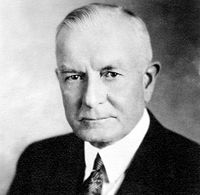
Might the cloud prove Thomas J. Watson right after all?

In 1943 former IBM president Thomas J. Watson allegedly *1 said: “I think there is a world market for maybe five computers". Will cloud computing prove Watson to be right after all?

Anyone who visited a computer-, internet- or mobile-conference in recent years, is likely to have been privy to someone quoting Watson. Most often to show how predicting the future is a risky endeavor. But is it? Maybe five for the world is not so crazy after all?

Now don’t get me wrong, I am not suggesting there will be less digital devices in the future. In fact there will be more than we can imagine (phones, ipads, smart cars and likely several things implanted into our bodies). But the big data crunching machines that we - and I suspect Mr. Watson - traditionally think of as computers are likely to reduce radically in numbers as a result of cloud computing. One early sign of this may be that a leading analyst firm – who makes a living out of publishing predictions - now foresees that within 2 years, one fifth of business will own no IT assets*2.

Before we move on, let’s further define "computer" for this discussion. Is a rack with six blades one computer or six? I’d say it is one. Same as I feel a box (or block) hosting 30 or 30000 virtual machines, is still one computer. I would even go so far that a room with lots of boxes running lots of stuff could be seen as one computer. And let’s not forget that computers in the days of Mr. Watson were as big as rooms. So basically the proposed idea is: cloud computing may lead to “a world market with maybe five datacenters”. Whether these will be located at the bottom of the ocean (think we have about 5 of those*5), distributed into outer space to solve the cooling problem or located on top of nuclear plants to solve the power problem, I leave to the hardware engineers (typical implementation details).

Having five parties hosting datacenters (a.k.a. computers) to serve the world, how realistic is this? Not today, but in the long run, let’s say for our children’s children. It seems to be at odds with the idea of grids and the use all this computing power doing little or nothing in all these distributed devices (phones, ipads). But does that matter. Current statistics already show that a processor in a datacenter with 100.000 CPU’s is way cheaper to run than that same processor in a datacenter with 1000 CPUs. But if we take this “bigger is better” (Ough this hurts, at heart I am a Schumacher “small is beautiful” *6 fan) and apply it to other industries, companies would logically try and have one factory. So Toyota would have one car factory and Intel one chip factory. Fact is they don’t , at least not today. Factors like transport cost and logistical complexity prevent this. Not to mention that nobody would wont to work there or even live near theseand that China may be the only country big enough to host these factories (uhm, guess China may be already trying this?).

But with IT we theoretically can reduce transport latency to light speed and logistical complexity in a digital setting is a very different problem. Sure managing 6000 or 600.000 different virtual machines needs some thought (well maybe a lot of thought), but it does not have the physical limitations of trying to cram 60 different car models, makes and colors through one assembly line. If instead of manufacturing we look at electricity as a role model for IT - as suggested by Nicholas Carr - then the answer might be something like ten plants per state/country (but reducing). Now we need to acknowledge that electricity suffers from the same annoying physical transport limitations as manufacturing. It does not travel well.

So guess my question is: What is the optimal number?
How many datacenters will our children’s children need when this cloud thing really starts to fly.
  • A. 5 (roughly one per continent/ocean)
  • B. .5K (roughly the number of Nuclear power plants (439))*3
  • C. 5K (roughly 25 per country)
  • D. .5M (roughly/allegedly the current number of Google servers)*4
  • E. 5M (roughly the current number of air-conditioned basements?)
  • F. 5G (roughly the range of IP4 (4.2B))
Please post you thoughts / votes / comments below


*1 Note: Although the statement is quoted extensively around the world, there is little evidence Mr Watson ever made it http://en.wikipedia.org/wiki/Thomas_J._Watson#Famous_misquote
*2 http://www.gartner.com/it/page.jsp?id=1278413  
*3 http://www.icjt.org/an/tech/jesvet/jesvet.htm
*4 http://www.datacenterknowledge.com/archives/2009/05/14/whos-got-the-most-web-servers/  
*5 http://geography.about.com/library/faq/blqzoceans.htm
*6 http://en.wikipedia.org/wiki/Small_Is_Beautiful   

Friday, June 4, 2010

How the cloud give the consumerisation of IT a whole new meaning

This blog originally was published at ITSMportal.com on May 31st , 2010

The cloud essentially "consumerizes" all of IT, not just relatively unimportant bits like procuring personal hard- and software. This requires a whole rethinking of corporate IT, as the idea of any master design becomes unattainable. How can IT as a species survive this trend as it may render the education of a whole generation of IT-ers irrelevant? On the brighter side - it really caters for the talents of today's teenagers: consumption as a lifestyle.


The idea of consumerisation - users being allowed to freely procure their own personal hard- and software - has been around for a while. But few CIO's and even less heads of IT Operations have embraced it. Other than some token adoption, where users could choose between an iPhone or a Blackberry or where users got a personal budget to order from the company supplied catalog of pre-approved hardware, we see little adoption of the concept. The idea is that users can go to any consumer store or webshop and order any gadget they like, be it an iPad, laptops, printer or smart phone and configure these basically while still in the store to access their corporate mail, intranet and company applications. The idea originated when people wanted to use their 24 inch HD pc with 4 processors and mega memory - all essential to enjoy modern home entertainment and video and far superior to company standard issue equipment- to also do some work.

Cloud computing now makes such a consumer approach also possible at the departmental level. Department selecting and using non corporate approved or endorsed SaaS based CRM applications are the most commonly used example. But more interesting are the cases where departments - tired of waiting for their turn in the never reducing application backlog of corporate IT - turned to a system integrator to build a custom cloud application to meet their immediate needs. Several system integrators indicate that they have more and more projects where no longer IT, but the business department, is their prime customer. Contracts, SLA's and even integrations are negotiated directly between the SI and the business department, in some cases IT is not even involved or aware.

Now this is not a new phenomenon. We saw the exact same thing when PCs and departmental servers were introduced. Departments went off on their own and bought "solutions" from vendors popping up like the proverbial poppy seeds and often disappearing just a quickly after (remember Datapoint, Wang, Digital? And those were the ones that lasted). Guess who the business expected to clean up (integrate) the mess they left behind? Yes, the same IT departments they bypassed in the first place. One may even argue that: if IT had not been so busy cleaning up this mess over the last 15 years, they would have had a much better chance at building an integrated solution that actually did meet business's need. I am not of that opinion. With ERP we got this chance (and the associated billions) and still did not manage to keep up with the requirements, some things are just too vast, complex or simply change to fast to be captured in any master design.

So back to consumerisation. Although the trend has been far from whole heartily embraced by most corporate IT, it is continuing. In my direct environment I see several people who, instead of plugging their laptop into the corporate network at the office, take a 3G network stick to work. For around 20 Euros a month this gives them better performance accessing the applications they care about, not to mention it gives them access to applications most corporate IT department do not care for, like facebook, twitter, etc. Question is off course, can they do their work like that? Don't they need all day, full time access to the aforementioned fully vertically integrated ERP system? The answer is No. First of all, the vertically integrated type of enterprise that ERP was intended for, no longer exist. Most corporations have taken to outsourcing distribution to DHL or TNT, employee travel to the likes of American Express, HR payroll and expenses to XYZ, etc. etc. The list goes on and on.

All these external service providers support these services with web based systems that can be accessed from anywhere, inside and outside the company firewall. At the same time, the remaining processes that occur in the corporate ERP system are so integrated that they hardly require any manual intervention from employees. Consequently employees don't need to spend their time doing data entry or even data updates or analysis on that system. Any remaining required interaction is facilitated by directly interfacing with the customer via the web shop or via other web based systems. One could say that the world moved from vertically integrated manufacturing corporations to supply chain connected extended enterprises.

The question I will address in my next post is how does the cloud enabling consumerisation for enterprise applications play a role in this and what this means for IT moving forward.

On the supply side of IT, it means applications are best delivered as easily consumerable services to employees and others (partners, customers, suppliers). One large European multinational is already delivering all their new applications as internet (so not intranet) applications. Meaning any application can be accessed from anywhere by simply entering a URL and doing proper authentication. Choosing which applications to provide internally is based on whether there are outside parties willing and capable to provide these services or whether the company can gain a distinct advantage by providing the service themselves.

When speaking about consuming services, one should try and think broader than just IT services. The head of distribution may be looking for a parcel tracking system, but when asking the CEO or the COO they are more likely to think of a service in terms of something a DHL or TNT delivers. Services such as warehousing, distribution, but also complaint tracking, returns and repairs, or even accounting, marketing and reselling, all including the associate IT parts of those services. It is the idea of everything as a services, but on steroids (XaaSoS). Please note that even when an organization decides to provide one of these services internally, they can still source the underlying infrastructure and even applications "as a service" externally (this last scenario strangely enough is what many an IT person seems to think of exclusively when discussing cloud computing).

On the demand side of IT the issue is an altogether other one. How do we warrant continuity, efficiency and compliance, in such a consumption oriented IT World. If it is every man (or department) for themself, how do we prevent suboptimisation, In fact , how do we even know what is going on in the first place. How do we know what services are being consumed. This is the new challenge, and it is very similar to what companies faced when they decided to not manufacture everything themselves anymore, abandoning vertical integration where it made sense and taking a "supply chain" approach. Cloud computing is in many aspects a similar movement, and also here a supply chain approach looks like the way to go.

Such a supply chain approach means thoroughly understanding both demand and supply, matching the two and making sure that the goods - or in this case services - reach the right audience at the right time (on demand). IT has invested a fair amount of time and effort in better ways and methodologies to understand demand. On the supply side, IT till now assumed they were the supplier. In that role they used industry analysts to classify the components required, such as hardware and software. In this new world they need to start thoroughly understanding the full services that are available on the market. An interesting effort worth mentioning here is the SMI (Service Measurement Index) an approach to classify cloud services co-initiated by my employer, CA technologies and lead by Carnegie Mellon University.

After having gained an understanding of both demand and supply, the remaining task is "connecting the dots". This sounds trivial but is an activity that analysts estimate becoming a multi-billion industry within just a few years. It includes non-trivial tasks like identifying which users are allowed to do which tasks in this now open environment and optimizing the processes by picking resources that have the lowest utilization and thus cost. Because going forward scarcity will determine price especially in the new cloud world (which resembles Adam Smith's idea of a perfect open market a lot closer than any internal IT department ever did or will do).

Now off course all of the above won't happen overnight. Many a reader (and with a little luck the author) will have retired by the time today's vertically integrated systems - many of which are several decades old and based on solid, reliable mainframes - will have become services that are brokered in an open cloud market. A couple of high profile outages may even prolong this a generation or two more. But long term I see no other way. Other markets (electricity, electronics, publishing and even healthcare) have taken or are taking the same path. It is the era of consumption.

PS Short term, however, the thing we (IT) probably need most is a new diagraming technique. Why? From the above it will be clear that - in such a consumerised world - architecture diagrams are a thing of the past. And an IT person without a diagram is like a fish without water . We need something that allows us to evolve our IT fins into feet and our IT chews into lungs, so we can transition from water to land and not become extinct in the process. One essential aspect will be that unlike pictures of clouds and very much like real clouds, the diagrams will need to be able to change dynamically, much like pictures in a Harry Potter movie (it's magic). Who has a suggestion for such a technique ?

Thursday, April 22, 2010

Why Cloud spells C.o.m.p.e.t.i.t.i.o.n. for the average IT department

This blog was originally posted at ITSMportal by columnist Gregor Petri on April 19th, 2010

Competition seems to be a controversial topic for many in IT. We rather see ourselves as service providers, but typically as the only - or at least the preferred - service provider. The reason to start this new column series on 'The impact of cloud computing on IT service management' with this controversial topic is that there seem to be two independent train of thoughts around cloud computing. On the one hand cloud computing is seen as a way to make traditional IT more efficient, on the other it is seen as a way for users to source IT solutions directly. The first group talks about Infrastructure as a Service and private clouds, while the second talks less but rapidly implements Software as a Service solutions, often bypassing the IT department in the process. Both groups are implementing cloud computing, but from very different starting points. Somehow they need to start talking again; otherwise we either get ‘strangers passing in the night’ or ‘a train wreck waiting to happen’.

For the first time in its history IT is facing outside competition. Sure, outsourcing was no picnic, but outsourcing was more like subcontracting to a ‘friendly’ supplier than real competition. With cloud computing users can simply go outside to procure the services they need. I am currently watching an interesting example close by. While the internal IT department is scrambling to offer an in-house social media type collaboration environment, one user department already went outside. To protect the innocent we won’t mention whether this was a production, sales, marketing, R&D or other department, but you get the idea. Starting in Australia, furthest away from corporate headquarters - both in distance and time-zones - they set up a collaboration environment with an outside cloud provider. In just a few weeks every member of this global department started sharing their activities, thoughts, projects and enjoying the typical communication that people enjoy on social networks.

As this cloud service is low cost (even starting with free), easy to use and it offers anywhere, anytime access also from non HQ supported devices such as iPhones and home PCs, the chances of IT winning this department back for their corporate service are dim at best. One good soul tried to help IT by requesting a similar online watering hole from corporate IT. As instructed he filled out a service request form at the central service desk , but to date he is still awaiting the first response from IT (a first response likely to be questions about priorities, about what executive will sign this off and what cost center it needs to be charged to). Now this may not be a mission critical enterprise system, but similarly we see user departments contracting directly with system integrators to build new enterprise solutions on a PaaS platform. My point is that many IT departments still seem to be in denial on the realities of this new competitive world called cloud. Time for a wake-up call.

Now IT is not the first department in corporate history to face some serious competition. Here is a wake-up analogy from the consumer electronics industry (if you’re not big on analogies, just substitute 'application' for 'TV and 'IT' for 'factory' and 'cloud' for Japan). About two decades ago a company from my country was global market leader in color TVs. Back then the average life cycle of a TV, before a new model would arrive, was 3.5 years. The average price was fairly stable at around 800 Euro’s and basically all components were custom designed and produced in house. Becoming the head of a TV factory was the ultimate career dream for many in my home town. Just a few years later, after Japan and Korea entered the global market, prices had dropped by 40% (and continued halving every two years), new models replaced old ones every 6 months and innovations such as remote controls, stereo, PiP and c-text determined market leadership. Our local multinational nearly did not make it through this transition. To cope they introduced 'just in time”, 'total quality' and started 'design for manufacturing', heavily utilizing standard off the shelf components to accommodate the much shorter life cycles. And to top things off they stopped producing the main component (CRT’s) in house, instead they created a production joint venture (a.k.a. a 'cloud') with their biggest competitor.

Overnight the head of manufacturing had to change from being ‘the king of low cost production’ to ‘the fastest orchestrator of the supply chain’. Agility became the word. But agility did not replace the need for low cost, high quality or advanced innovation. It was about delivering all of those at the same time and at neck break speed. Some industries decided this was just too hard and stopped in-house manufacturing all together, others saw it as an opportunity for differentiation. In my view the above analogy graphically illustrates the roller coaster ride IT is about to get on.

Many of the needed skills and tools, such as smarter sourcing, resource pooling, and service oriented architectures; we have already been trialing in the past few years. Under the banner of agile development we even have had a first go at coping with rapid change, despite the overwhelming complexity of enterprise IT. In addition there are many manufacturing best practices, Lean being the obvious one, that IT can benefit from (see also 'How lean is your cloud').

The question in my view is: is IT ready and willing to give up their manufacturing role (provider of services) and transition into an orchestration/supply chain role. Essentially engaging in both mentioned conversations: making enterprise IT more efficient, while at the same time enabling the enterprise to leverage readymade market/cloud services. Interested in your thoughts and comments.

Sunday, April 18, 2010

The Cloud leans back – an iPad epiphany

Given the giant cloud of volcanic dust currently passing over Europe I could have also titled this blog "The cloud strikes back", but that is not the topic of this "the cloud changes everything" blog.  It also has nothing to do with my earlier topics on Lean IT and Lean manufacturing. Lean Back and Lean Forward were the guiding principles for developers of Interactive Television.

The idea being that TV is typically enjoyed leaning back, while computers are typically used leaning forward. Of course we all know that interactive television so far has been as successful as the NEXT computer (not). In fact, in the last 5 years we moved to a situation where more and more entertainment content is consumed leaning forward . If you visit our home on a typical Friday night the big ass TV may be on, but meanwhile all family members are hammering away on computers. Mom on the desktop, the kids fighting over who gets the macbook versus the laptop and Dad on his company supplied artifact.

Now only a few years ago, you assumed that any person using a computer was probably working. (back then only dad would be using his computer on a Friday night). One of the first I saw point out this blurring of work, home and play - as illustrated below -  was IT visionair Peter Hinssen (t) , in one of his hilarious but at the same time highly educational sessions on IT strategy.


However, something felt wrong about this. Maybe it is a generation thing, but if the above is your life, then how much of a life is it?

Luckily help has arrived, but not from interactive TVs.  If a family of 4 can barely agree what TV channel is to provide the background noise to their computing activities, how would they agree on one joint interactive activity. This new reality was vividly described by Robin Bloor , one of the first industry analyst and author of havemacwillblog.com.  In how  "The iPad Will Replace The Laptop" he describes numerous use cases of how "lean forward" is no longer needed to have a good and/or productive time online. If you're a person dying to get an iPad (like most of us in Europe) but also if you interested in the future of TV or indeed ... in the future of the cloud ... then this is a must read story.

Important to realize is that this is NOT about switching devices, but about a  fundamentally different way to interact with content and functionality (a.k.a. with the cloud).  People are interested in taking a ride, not in the art of motor cycle management or ownership. And that is exactly what the cloud brings. In fact, Google referenced the same phenomena when launching their latest incarnation of Google Docs. They stated that about as many people should need an office suite as need photoshop, autocad or similar. Most people read or at best annotate, only very few create. 

In this light, the decision of the Library of Congress to preserve the first billion tweets for prosperity (including interesting twitbits "like what did Dave or Joe or Bob  have for Lunch on Monday Aprill 11th" may not be so stupid after all. The "we are all authors" movement may turn out to have been an one-time phenomena caused by temporary ubiquity of keyboards. Let's face it, writing 2500 tweets for 7 followers is not a fulfilling, economic or even sensible activity, let alone reading them (if you don't believe me have a try). Similarly we may realize that the volume of email we all complain about , is because we all spend too much time typing and not enough time reading. 

I think we can all agree Apple already changed the computer industry several times and is revolutionizing the music industry. With the iPad they will now be changing the TV industry (Apple TV was not a failure, it is just infrastructure for the iPad)  and by leaving out a keyboard they now also created the ultimate work, home and play "cloud consumption experience".  


This may mean that we are going back to an time where people using PCs are not just the ones working .  They are likely to be the ones creating cloud stuff: content creators and functionality developers (a.k.a . IT folks).  All other people - working, relaxing  and playing - will be doing so on cloud consumption devices.

Case in point, from a tweet by Cap Gemini's CTO Ron Tolido: "Need to run a country? We have an app for that" that points to Norway's prime minister running the country from his iPad while stranded due to the aforementioned volcanic cloud.  So lean back (or lean forward - depending on your job area) and enjoy the ride.


PS Some of you may point out that for that for the above to work, it would be a good idea if Google Docs actually worked on the ipod . In typically IT fashion we would call this an "implementation detail", but feel free to point it out to Google, preferably before I get a chance to pick up my iPad from Europe.

Note: I could not find the original author or copyright holder of the Modern Life cartoon, any pointers appreciated.


Sunday, April 11, 2010

A cloud experiment @ ComputerTotaal!

ENGLISH: Started my one-time guest editorship of ComputerTotaal!, by far Holland’s largest monthly IT magazine. Goal is to make the summer edition (#8) one of the world’s first and largest experiments in cloud collaboration.

Lead by 5 guest editors, reviewed by an editorial board of several hundred and with potential contributions from the 100K+ readership, the content of this edition is to be created and reviewed in, on and through the cloud.

One of the aspects to be evaluated are the collaboration possibilities that Office 2010 and Microsoft’s consumer cloud platform such as SkyDrive are to deliver. But also alternatives like Google Apps and other SaaS options will be reviewed. Social cloud aspects reviewed include the blurring of work, play and home activities.

Interesting is that although this is clearly an experiment, which even uses a beta (office2010) to create the content, the over hundred thousand strong paying readership and the numerous advertisers of the magazine http://idg.nl/producten/1/computer-totaal/ do rightfully expect the quality to be at least on par with traditional methods. Very much like we see in today's “enterprise cloud experiments".


DUTCH: Vandaag begonnen als gast redacteur voor de zomer editie van ComputerTotaal!, Nederlands grootste IT en PC magazine.

De creatie van deze zomer editie (# 8) is volgens mij een van de eerste en grootste cloud samenwerkings experimenten in de wereld. Aangevoerd door een team van 5 gastredacteuren, bewaakt door een redactieraad van meer dan honderd en met potentiële bijdragen van de honderd duizend lezers, wordt de inhoud van deze uitgave in, op en door de cloud gecreëerd. Idee is om the beoordelen of een dergelijke samenwerking mogelijk gemaakt kan worden door nieuwe platformen zoals Office 2010 in samenwerking met Microsoft consument cloud platform: Skydrive. Maar ook alternatieven, zoals Google Apps en andere SaaS-opties worden bekeken. Daarnaast word aandacht besteed aan mede door de cloud veroorzakkte of ten minste mogelijk gemaakte vervaging tussen traditionele werk, spel en thuis activiteiten.


Interessant is dat hoewel dit duidelijk een experiment is, dat zelfs gebruik maakt van een beta release (office2010) voor het creëren van de inhoud, de meer dan honderdduizend betalende lezers en de vele adverteerders terecht verwachten dat de kwaliteit van dit nummer beter of tenminste gelijk moet zijn aan de traditionele nummers. Ook daar lijkt het dus erg op de "enterprise cloud experimenten" die hier vaak beschreven worden.

Wilt u de voortgang volgen op Twitter, zoek dan op hastags #computertotaal AND #office2010 http://twitter.com/#search?q=%23computertotaal%20%23office2010  

Wednesday, March 31, 2010

Notes from the Cloud Academy: RAIC - Redundant Arrays of Inexpensive Cloud services

We have been running the Cloud Academy roundtables in several European countries. I’d like to share some of the more interesting questions, debates and insights around a number of topics, starting today with RAIC—Redundant Arrays of Inexpensive Cloud Services. Other topics will include:

  • A TV industry analogy: Competition for the IT department
  • Cloud Shortcuts: Can the Cloud make( internal) IT more agile
  • Service Level Management and the Cloud
  • Cloud R&R - Retained responsibilities for IT
  • Elastic Services: Everybody wants to be a manager  


Redundant Arrays of Inexpensive Cloud services
Today’s post discusses whether we can ensure performance and availability of public cloud services. I’m not sure we can. Public cloud services are a bit like the weather: we are lucky if we can predict what it is going to be like, but cannot manage or change it as we don’t control the underlying elements. The same holds true trying to “manage” public cloud services.

So what do we do? Give up on public cloud services altogether? No, that would be throwing out the baby with the bathwater. Instead, we can follow a method we have been using in IT for a long time. If we cannot count on a certain item to be always available, we make sure we have a fail over option.

The best example comes from storage. At a certain moment, people realized that even the most expensive disks encountered failures now and then. So they developed a strategy where failure of an individual disk is not so important. The result was RAID, a redundant array of inexpensive disks that, transparently tot the user, served the requested data from other disks in the array when one of the disks failed. In typical IT fashion, we used the name RAID 0 for a configuration where we had no raid at all, RAID 2 for 2 disks etc. The benefit of higher raid numbers is is that the predicted availability increases significantly by adding marginally more redundant capacity.

How do we apply a similar “redundant array” approach to cloud services? The idea of contracting for two email services or two CRM systems is counter-intuitive for most IT folks, since for years we strived to standardize on one of each . And the reality is that if half the company uses one email system and the other half another, 50% of the people are still down if one fails. So instead of looking at email in isolation, we should look at all the employee communication options. These may include email, instant messaging , VOIP, even a social media functions similar to Facebook or Twitter. If based on different technologies and sourced from different vendors, the chances of them all being down at the same time is extremely unlikely.
Using chat or instant messaging as a backup for email is not how we traditionally think in IT---- and challenging such traditional thinking is exactly the idea of the Cloud Academy - but it aligns with the next generation of IT users. An example: Teenagers (like the two living in my home) instantly switch from MSN to Google chat or to Hyves or Facebook or even to hotmail or text messaging, if the service they are using is behaving strangely. They are not particularly interested in whether a particular service is down; their only interest is whether they can continue to communicate with their friends.

Of course, since today’s IT departments proactively monitor the infrastructure and know the status of systems, they rarely get a call saying “all systems are down.. But that’s not true with external cloud services. We need to find an alternative early- warning system, something like a weather report on the status of the external cloud services our user depend upon. An interesting site in this context is http://www.unifiedmonitoring.com/.

So what conclusions did we reach in our (sometime heated) Cloud Academy debate?
Using public cloud services is another step in giving up control of the underlying components. Years ago, when companies bought the first computers , they were expected to program these themselves in Assembler. Later, they bought higher- level language compilers, followed by complete off the shelf software packages followed now by infrastructure and software as a service. Along each step, IT has lost some control, but in exchange we are no longer required to do all the work.

We do, however ,have to make conscious decisions when to cede control. This differs by industry, type of application and possible risk. Using public cloud services in many cases already makes sense today. But when using them, we need to have some way to monitor availability and outcome so that we can make smart or pragmatic tradeoffs and precautions when the services are not available.

Monday, February 15, 2010

How Lean is your Cloud? Part 2

In the first part we discussed lessons that IT can learn from a hundred years of manufacturing best practices and the possible role of cloud computing in that endeavor. We now continue with what may very well be the area that IT can learn most from manufacturing: Costing.

Costing. Many feel that the billions that the industry invested in ERP systems can be justified by the improved planning capabilities that such a global perspective gives. Reality however is that the benefits of ERP – if any – come more from improved financial visibility. By being able to compare costs, prices and efficiencies per country, the overall portfolio could be optimized. And although most ERP systems have added a supply chain planning solution over the past years, their cost analysis and financial functionality is often both more advanced and more widely implemented.

Full, loaded, integral products cost. In manufacturing understanding the cost of a product is both an art and a science. Using a variety of tools and methods direct and indirect cost elements are allocated to cost carriers (products). In fact, most manufacturing innovations are first screened against their impact on product cost, before their implementation is even considered. The two main allocation methods are a roll up based on the Bill of Materials (BOM) and an activity based allocation using intermediate pools of costs. IT cost and especially infrastructure cost traditionally were fixed and allocated in an overhead way. With CMDB’s (configuration management databases) becoming more widely implemented , organizations can start to allocate specific technical cost directly to the business service they support. And also the pay as you go model of cloud computing makes that easier. As a result many an IT department is starting their own financial and cost analysis function or department. Something which is also required as cloud computing renders make or buy decisions more granular and more frequent.

Global sourcing and spot markets. It will be clear that under the above market conditions, smart sourcing becomes a key competitive differentiator. Static long term contracts and multi-year commitments are replaced by spot markets, hedging and pricing based on average daily price. Also in Cloud computing we already see the first examples of this, again with Amazon leading the pack by introducing spot pricing for its EC2 elastic cloud offering.

Just in Time. At first sight Just in Time manufacturing seems to be at odds with a focus on product cost. Making large quantities to stock (just in case) seems more efficient than producing each item when and only when required (just in time). The revolutionary idea of lean manufacturing was that if it is more efficient to make hundred of the same in a row, the conclusion should not be to make batches of a hundred, but to change and tweak the system until a batch size of one could be produced as efficient as a batch of hundred.

Single Minute Exchange of Die. SMED, sometimes jokingly referred to as “single minute exchange or die”, is the practice where the whole factory team works together to change over the manufacturing process from one type of product to another, within a minute. Imagine a formula one team getting ready to exchange tires, including a guy with a whistle and endless rehearsals and you get an idea how serious this practice is taken in lean factories. To most of us this may feel outrages and expensive. But in fact this singular focus on achieving together what everyone agreed is important (in this case make to order and meeting real and not forecasted customer demand) and makes SMED relevant in a cloud context. In the past, each IT department or discipline (network, databases, applications, development, etc.) - could focus on meeting their own SLA’s, but all together they often were delivering an overall customer experience that was less than desirable. Case in point, also with cloud computing is that improvements cannot come from only technology (cloud in this case), it has to be grounded in mentality and processes.

Total Quality. Before lean manufacturing introduced the concept of zero defects, the consensus of the industry was that there was something like “optimal quality”. The idea behind that was that if one in X-thousand products failed, it was cheaper to repair those few then to improve manufacturing quality even further. It will be clear that Just in Time and zero inventories had no tolerance for that idea. If even a single component fails, the whole delivery to the end customer will get delayed severely. As a result manufacturing started measuring defects in PPM (Parts per million) instead of percentages or promille’s. Basically the idea was that manufacturing something first time right in the end always is cheaper than having to repair it later on, as all these unplanned repair activities are essentially waste that adds no value. Also in IT the idea of “first time right” is gaining traction and cloud computing, with its large scale, is accelerating this even further. With a million users the impact of an error or (security) flaw is much higher and does warrants a larger focus on quality. Interestingly this focus on zero defects also further another lean concept, namely excluding any functions that the user sees no value in , as these do increase complexity and the chances of errors, but not the value.

Maximize Value, Minimize Waste. Even if the above analogies between Lean manufacturing and IT may seem far fetched to you, one thing you may find useful regardless is using the Lean IT mantra of “Maximizing Value” (only do what adds value to the end customer) and “Minimizing Waste” (eliminating steps that do not add value) to guide your decisions. Just take any idea or proposal and evaluate it against these two simple criteria: does the service in question add significant value in the eyes of your end customer? Or, does it minimize waste by eliminating steps that do not add value relevant to your customers. These two very simple criteria can also prove very useful in streamlining your cloud computing efforts.

Now is the time for organizations to start evaluating how cloud computing can help them transform their traditional IT factories into a modern IT Supply Chain. With the Cloud Academy initiative we are trying to support these efforts. On the one hand by furthering knowledge about basic cloud building blocks and cloud security, but also by discussing possible management approaches to cloud computing in the Cloud Academy discussion group on Linked-In. Regardless of whether you are looking to start your journey to cloud computing with Software as a Service, Platform as a Service or Infrastructure as a Service. May your cloud be a lean one!

How Lean is your Cloud?

Delivering IT services can be in many ways be compared to manufacturing processes, and over the years the concept of an “IT factory” has become a popular way of explaining best practices in IT operations. In this tradition Cloud Computing can be seen as the logical next step, converting the traditional IT factory into a modern IT Supply Chain (see also the recent whitepaper by Sam Somashekar).

The ambition to model IT after manufacturing is understandable. The enormous efficiency improvements gained from innovations in manufacturing management have enabled the economic growth and prosperity of the past decades. With the economy moving further from Atoms to Bits - from tangible products to information services - it makes sense to investigate whether these management innovations can have similar effects on IT. Of course not instead of existing service management best practices, these will remain valid. But as additional source of inspiration.

An additional reason for using such manufacturing analogies is that they provide an easier way to explain the rationale behind major IT investments to non-IT trained audiences, such as the executives needing to sign off these investments. Using the widely accepted best practice of Lean Manufacturing as main analogy we try and investigate the possible relevance of Cloud Computing in that context.

Mass production. Today’s cloud computing offerings all leverage the concept that mass produced is almost always cheaper than custom made. The proverbial Ford Model-T was all about using standardization to drive cost down - any color as long as it is black! Today’s cloud computing offers mass produced standardized services to millions of users, and as a result monthly cost per user can be relatively low.

Mass Customization. But soon consumers no longer accepted only black cars and in Japan Toyota perfected lean manufacturing to be able to offer choice at cost comparable to mass production. Instead of an assembly line dedicated to one make and model, all kinds of different cars ran on the same production line. Thanks to virtualization IT is likewise abandoning “One server per app” and is running multiple applications in varying combinations on a flexible cloud infrastructure. In a comparable way, multiple customers are using the same Software as a Service application in very different ways. In this case the concept of multi-tenancy makes such premium flexibility at the cost of mass production possible.

Mass Standardization in product design. The secret behind mass customization in manufacturing is massive standardization of the underlying components and platforms. In the consumer electronics industry the average manufacturers’ portfolio of television sets went from ten different models - with an average shelf life of two years - to hundreds of different models with major product renewals occurring every 6 months. Product development lead times needed to be slashed from years to months. And smart manufacturers moved from every TV having its own custom designed printed circuit boards to using the same board across most of its models. Agile development and component reuse are the IT incarnations of this trend.

Assemble to Order in product delivery. Before industrialization most products were “made to order” by craftsman. Post World War II, with demand high and supply low, the market went to products “made to stock”. As the market changed from a sellers to a buyer’s market, customers demanded differentiated products at low prices and with short lead times. To be able to meet these higher demands manufacturers perfected an assemble to order supply chain. Where final products were rapidly assembled from low cost often purchased standard components. IT went through as similar transition, moving from tailor-made software via standard packages to a service orient architecture, where end user services in theory can be assembled to order. In a cloud computing context this means sourcing low cost component services and flexibly assembling these either in house or using a platform as a service.

Design for Manufacturing. An approach where R&D designed products and then threw these over the fence for Manufacturing to figure out how to produce them was no longer feasible in modern manufacturing. Products need to be designed with manufacturing in mind. In most modern manufacturing organization R&D and production work very closely together, throughout the whole product life cycle. In a similar fashion we already see that product developers at today’s cloud providers are much more involved with “how it will run”, than traditional developers. With automatic provisioning and scaling up and down of applications becoming standard practice, “design for operations” will be a required discipline for all developers going forward.

Deliver double the features, at halve the cost, every 12 months. Seems outrages? In consumer electronics this may even be understating the market dynamics. Designing and manufacturing products that by the time they reach the market will sell for half of today’s price is no picnic. IT will need to prepare for similar market dynamics. To some extend hardware and basic services like bandwidth and hosting are already keeping up with this rapid cost reduction. But IT needs to prepare for their “Premium Services” to meet these requirements too. The impact of the cloud is here that - with bandwidth making both distance and time-zones irrelevant - competition can come from everywhere.

From Manufacturing Requirements Planning (MRP) to Supply Chain Management (SCM). The main difference between traditional MRP and SCM was that MRP tried to plan the organizations own manufacturing activities, while supply chain planning took into account the activities of the extended enterprise and at the same time acknowledged that not all parameters were under the control of the planner. If the ship transporting cars from Kobe to Rotterdam left on the 12th then production needed to be planned around that. Just like one cannot manage the weather, one can merely predict it and plan around it. Same with Cloud Computing, many of the components required for the final customer experience are no longer under our (direct) control, but we remain responsible for the final result and need to plan around obstacles.

Synchro Kanban. A result of the above is also that trying to micro manage that macro environment is not a good idea. Micro managing would be a futile as having trained butterflies take off from the coast of Japan to prevent a hurricane in Central America. Instead one can better take an approach where the internal management capabilities of the individual subsystems are leveraged. Toyota’s Synchro Kanban approach is a good example. Having a macro level plan that looked factory to factory and country to country level, while each factory was responsible for meeting its commitments using its own capabilities and flexibility. They did so using really simple low tech systems such as Kanbans or dual bins. The perceived centralization of cloud computing has the danger of inviting megalomaniac global planning attempts, but in my view the idea need to be Keep it Stupidly Simple (KISS) just like with synchro kanban.

Continuous Incremental Improvement. It is tempting to assume that such high requirements also require a wholesale approach to innovation. Starting over by building a new factory instead of trying to improve the old factory. With the exemption of some base components in most industries the incremental approach of trying to improve an already working factory has proven much more effective than trying to get a brand new factory to work. With Service Oriented architectures that realization is reaching IT, not building yet another new factory next to our current mainframe, unix, and windows manufacturing plants of the past.

Dedicated new factories In manufacturing there is one clear exception to the above, factories for new base components such as chips or LCD screens are replaced completely when moving to the next generation of product. Also here a possible lesson for cloud computing, for base services, like CPU capacity, storage but also search and mail, it may make sense to plan for an ability to regularly switch vendors (factories) going forward. Locking in to a particular vendor also locks in to that vendors generation of technology and thus to its related no longer competitive cost model.

To be continued….in part 2